

MONICA KIM GARZA | JEFFREY CHEUNG | VALENTINA GRILLI | LUCIA JONES | SIMONE MICCICHÉ | DANNI PANTEL | ZEHUI XU, I am no longer
Opening 09 April 2026 h 6:30 p.m., Via Argelati n° 24, 20143 Milano (MI)
Until 22 May 2026
MONICA KIM GARZA | JEFFREY CHEUNG | VALENTINA GRILLI | LUCIA JONES | SIMONE MICCICHÉ | DANNI PANTEL | ZEHUI XU, I am no longer
09 April - 22 May 2026
I AM NO LONGER
Opening Thursday, April 9, 2026 at 6:30 p.m.
April 9 - May 22, 2026
Galleria Patricia Armocida is happy to announce “I Am No Longer”, a group exhibition with works by Monica Kim Garza (Alamogordo, USA, 1988), Jeffrey Cheung (San Francisco Bay Area, USA, 1989), Valentina Grilli (Milan, 1983), Lucia Jones (Wales, UK, 1992), Simone Miccichè (Bologna, 1992), Danni Pantel (Erlangen, Germany, 1989), and Zehui Xu (Weihai, China, 1998) opening on Thursday, April 9th at 6:30 p.m.
“I Am No Longer” is a phrase made up of just four words, deliberately incomplete: an ellipsis that reveals a space of silence, marking a before and an after, a rupture and at the same time a transformation. It is a threshold of narrative and identity that runs through the practices of the artists in this exhibition, inviting us to reflect on the processes of change in the self, on identities in flux, and on the tensions between memory, body, space, and representation.
For Monica Kim Garza, “I Am No Longer” represents the rejection of an imposed identity and the dissolution of a self shaped by societies gaze, giving way to the possibility of a self-determined. With expressionist brushstrokes and bold tonal palettes, her paintings place female figures— often nude— within lush, atmospheric settings, suspended between reality and imagination. Whether reclining, lifting weights, drinking, or playing sports, the women in her works embody a free and playful presence that reclaims space with irony, sensuality, and autonomy.
In Valentina Grilli's work, a suspended dimension emerges in which space becomes a stage for evanescent presences and traces of human passage. Her practice revolves around the concept of limen, the threshold, not only as a physical boundary but as a site of tension, transformation, and possibility. Within these rarefied atmospheres, we are invited to confront the uncertainty of passage and the space of possibility. The artist has recently turned her attention to still lifes, reinterpreted as a sort of contemporary archaeology: seemingly insignificant objects become carriers of everyday memories, repeated gestures, and minor narratives.
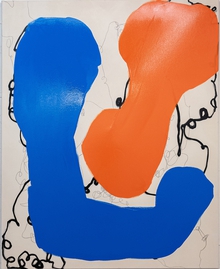
Danni Pantel's works reveal a tension between apparent surface perfection and inner complexity. From a distance, the surfaces may appear smooth and defined but upon closer inspection, more complex and textured structures emerge. This contrast suggests a passage from the visible to the invisible, inviting us to approach and explore what lies hidden beneath the surface.
Pantel does not try to represent external realities or specific narratives; rather, she seeks to expose a psychological, emotional, and often confused depth, bringing to light the “hidden” that usually remains within. Her works are spaces of tension between control and vulnerability, expressing human fragility through expanses of color and evocative marks.
Jeffrey Cheung’s bright figurative work explores human connections through joyous figures and vividly colored nudes that twist, embrace, and playfully interact. His work combines exaggerated forms, layered textures, and dynamic bodies, creating a sense of movement and vitality that draws the viewer into intimate, imaginative scenes. By blending humor, sensuality, and a tactile approach to materials, Cheung transforms everyday gestures and social encounters into visual narratives that examine freedom, identity, and community.
Simone Miccichè’s paintings speak to the long tradition of drapery in art by reinterpreting it through a contemporary lens. His project “Corpo Tessuto” explores, through painting, the absence and origin of a migrant body, constantly displaced due to geopolitical circumstances. It is a rediscovered body that, in contemporary narratives, is often represented by the media as covered, hidden, or wrapped in anonymous, sterile cloths. The fabric thus becomes a sensitive archive: a surface capable of retaining memories, gestures, and collective identities, as well as the frictions and asymmetries of power that span the history of bodies and territories.
Through her work, Lucia Jones pursues an exploration of female identity and the social pressures that shape how women are seen — by others, and by themselves. Her paintings navigate the tension between constraint and self-determination, drawing on found imagery from cinema and art history to place women in surroundings that mirror their inner worlds. Curtains, a recurring motif in her paintings, suggest a tension between concealment and exposure, between what is revealed and what remains hidden. The result is a reflection on the complexity of female identity and the quiet resilience required to maintain authenticity and autonomy within these dynamics.
Zehui Xu explores the subtle relationship between memory, absence, and inner space. Through layering and erasure, her works create images suspended between presence and disappearance. Colors such as pink, blue, and purple flow across the pictorial surface like fragments of nearly forgotten dreams, composing an inner landscape that exists between personal memory and collective experience. By concealing and revealing figurative elements, her paintings seek to capture the fragile and persistent nature of memory, at once intimate and shareable.
Through different languages and sensibilities, “I Am No Longer” constructs a collective dialogue around the idea of transformation: an exploration of identities, bodies, memories, and spaces that challenge established narratives and open new territories of possibility.